Cooking on Induction Off-Grid: The Ultimate Guide to Power, Batteries & Setup

f you are looking to ditch gas and switch to induction in your camper, boat, or tiny house, you’ve probably realized one thing: there is a lot of conflicting information out there. Can it be done? Yes. Is it as simple as just plugging it in? Not quite.

In this guide, we’re going to figure out exactly what kind of electrical system you need to cook off-grid. We won’t just guess; we’re going to break it down into clear, logical steps based on real-world testing:

  1. Real-world power consumption: What is actually happening when the pans are on the hob?

  2. Inverter selection: Choosing the right “engine” for your AC power.

  3. Energy vs. Power: Calculating your daily consumption over time.

  4. Battery Sizing: How big should your “fuel tank” be?

  5. The Voltage Debate: When does 12V stop making sense, and when is 24V the smarter choice?

My name is Gijs, and I’ve been helping people build their off-grid electrical systems since 2021. Let’s dive into the data.

Table of Contents

You can also watch the video below:

What is actually happening electrically while we’re cooking?

To get real answers, we need a real test setup. For this experiment, I’m using a 3000VA Victron MultiPlus and a 314Ah WattCycle Lithium battery. The induction cooktop is rated at a maximum of 3500 Watts.

But here is the first thing you need to know: that “3500W” label doesn’t tell you much about your daily use. Power consumption depends entirely on the level you select.

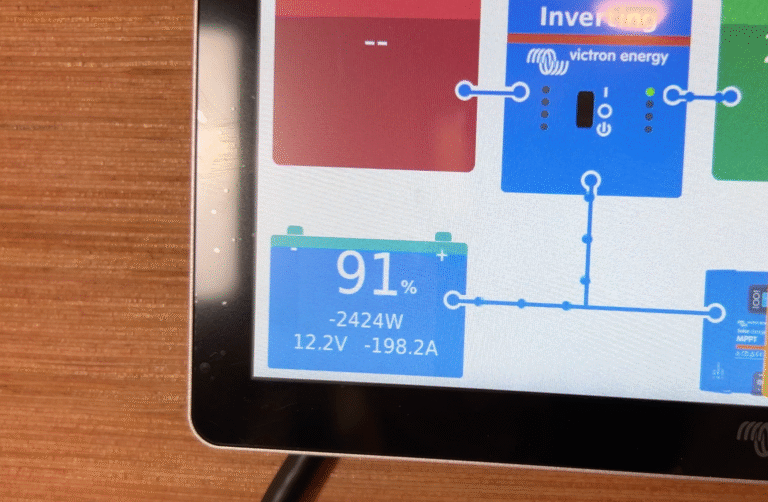
In our test, we boiled two pans of water to simulate a simple pasta meal. At this moment, we were drawing between 1000W and 1300W continuously. However, induction hobs don’t always draw power linearly; we saw peaks hitting 2400W to 2500W.

Why this matters: If your system can’t handle those peaks, your kitchen shuts down before the water even bubbles. You need to design for the peaks, not just the average.

Image of how much power an induction cooktop uses

What does this mean for your inverter?

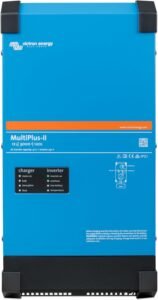
An induction hob is an AC appliance, but your battery stores DC power. The inverter (in this case, the MultiPlus) is the bridge between them.

Since we measured peaks of 2500W, your inverter must be able to supply that amount of continuous power safely. This is why a 3000W/VA inverter is the gold standard for induction cooking.

Pure Sine Wave vs. Modified

You cannot cut corners here. Induction hobs use high-frequency electronics to create a magnetic field. They require a Pure Sine Wave inverter. If you use a cheaper “modified” sine wave inverter, you risk damaging the hob or, at best, it simply won’t start.

The “Power Assist” Advantage

Because we are using a Victron MultiPlus, we have a secret weapon: Power Assist. If you are ever at a campsite with a limited 4A or 6A connection, the MultiPlus can “help” the shore power by adding battery power to the mix. This prevents the campsite’s breaker from tripping while you’re cooking your steak.
Why designing your system first matters

Before we move to the battery calculations, a quick side note. Building an off-grid system is like building a house; you need a blueprint.

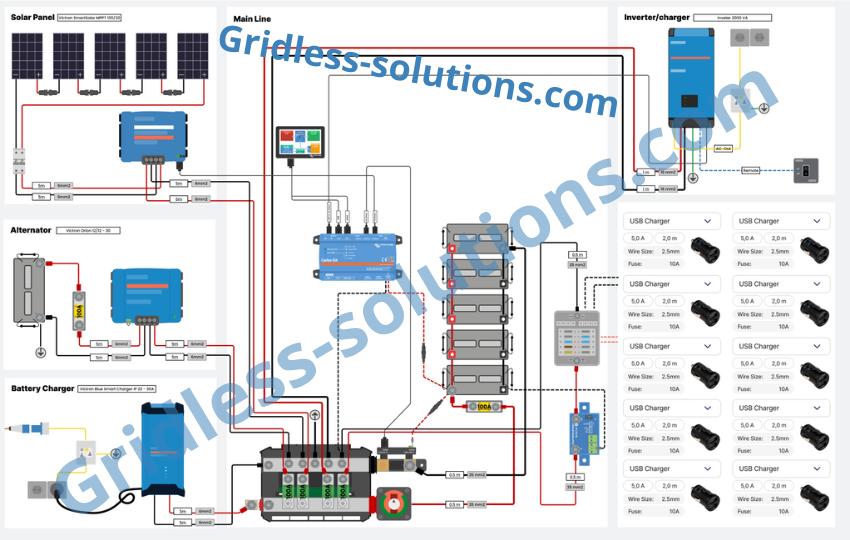
If you are struggling with which wires to use or how to fuse your induction setup, check out our software. It allows you to create clear wiring diagrams where all fuses and wire thicknesses are calculated automatically. Suitable for 12V, 24V, and even 120V, 230V and 240V AC systems. It saves you from making expensive (and potentially dangerous) mistakes.

Insert Image: Screenshot of the software showing an induction cooking wiring diagram.

Wiring diagram victron smart inverter - gridless solutions

From cooking power to energy use (The 30-minute test)

So far, we’ve talked about Power (Watts)—the “speed” of the electricity. But for your battery capacity, we need to talk about Energy (Watt-hours)—the total amount used over time.

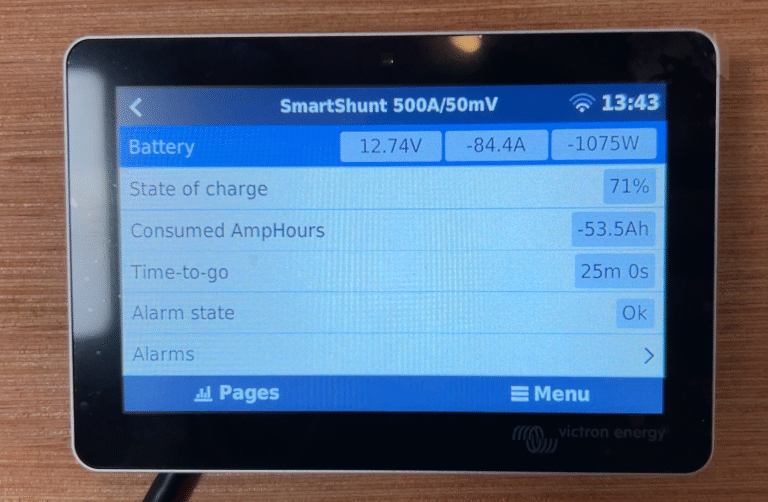
For our test, we boiled 5 liters of water in two pans for 30 minutes.

  • Starting capacity: 100%

  • Ending capacity: 71%

  • Energy used: 690 Watt-hours (which is roughly 54Ah at 12.8V).

Now, let’s look at a full day. If you cook for 10 minutes in the morning and 30 minutes in the evening, your total cooking time is 40 minutes. Based on our data, that means your induction hob alone will consume around 920 Watt-hours per day.

Image of how much energy is used during 30 minutes of cooking on a induction cooktop (off grid)

How big does your battery actually need to be?

To size your battery bank, we need to look at four things:

  1. Your total daily Watt-hours (including fridge, lights, etc.).

  2. How many days you want to be off-grid without charging (autonomy).

  3. The efficiency of your inverter (usually around 90%).

  4. Your system voltage.

The Calculation

  • Cooking: 920Wh

  • Other appliances (Fridge, lights, pump): ~440Wh

  • Total daily use: 1360Wh

If you want to stay off-grid for two days without sun or driving:

In a 12V system (), you need roughly 213 Amp-hours. However, because of inverter losses and a safety margin, we recommend rounding this up to at least a 250Ah or 300Ah battery bank.

The BMS: The gatekeeper of your power

This is the most critical part of your battery choice. Your Lithium battery has a BMS (Battery Management System). As we saw, the hob pulls nearly 200 Amps at 12V. If your battery’s BMS is only rated for 100A, it will shut down immediately.

Rule of thumb: For induction, you need a battery (or a combination of batteries) with a BMS that can handle at least a 200A continuous discharge, preferably 250A.
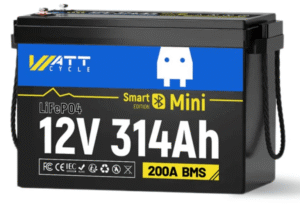
wattcycle 314ah mini battery
Get 6% discount with code: Gridless

Available at

wattcycle.com

12 Volts or 24 Volts?

In our test setup, we used a 12V system, and it works. But there is a “switching point” where 24V becomes much smarter.

Personally, if you are planning to use an inverter of 2000W or larger, I recommend a 24V system. Here is why:

  • Current: 2000W at 12V is 167A. At 24V, it’s only 83A.

  • Cables: Lower Amps mean you can use thinner, cheaper cables.

  • Efficiency: Less heat is generated, meaning fewer energy losses and a safer system.

While induction is possible on 12V, 24V gives you more “breathing room” and efficiency in a high-power setup.

Final Thoughts: Is induction right for your camper?

Induction cooking in a camper or boat works extremely well, but it depends on your travel style.

  • Summer travelers: With plenty of solar, induction is a dream.

  • Full-timers: In winter or rainy climates, it can be challenging. If you only drive an hour a day and have no sun, your alternator might not be able to replenish those 1360Wh.

It’s all about balance. Induction offers safety, speed, and a gas-free life, but it requires a well-designed heart: your electrical system.

Ready to start your build? Don’t guess your wiring. Check out our design software to build your system with confidence. And if you want to learn even more, download our free 92-page ebook where we explain everything about off-grid electrics.

Thanks for reading, and I’ll see you in the next one!


Leave a Comment

Your email address will not be published. Required fields are marked *

Scroll to Top