How to run a Nespresso machine off-grid

Making a cup of coffee off-grid sounds simple, until you plug in a Nespresso machine and suddenly everything shuts down. In this article we are going to look at what you actually need to power a coffee machine from a battery system, using real electrical numbers instead of guesses. We will walk through how much power a Nespresso uses, how to choose the right inverter, how that translates into battery current, and what type of battery can realistically handle that load. If you are building a camper, van, 4×4 or boat electrical system, this will give you a very concrete reference point.

The short version is this: to reliably run a Nespresso off-grid, you need about a 1500 watt pure sine wave inverter and a lithium battery with a battery management system that can handle at least 150 amps of continuous discharge. Below we will go through the full reasoning so you can understand exactly why.

Table of Contents

Prefer to watch a video? ⤵️

How much power does a Nespresso machine use?

Every off-grid system starts with the same question: how much power does the appliance actually need? Most Nespresso machines and comparable capsule coffee makers use between 1200 and 1500 watts when they are heating water and brewing coffee. In our case, the machine we are using is rated at 1300 watts. That means that while it is brewing, it is drawing 1300 watts of AC power from the inverter. This is the number we need to design the rest of the system around.

Choosing the right inverter

Your battery system works on DC power, usually 12 or 24 volts, while your coffee machine works on AC power, typically 120 or 230 volts. The inverter is the device that converts the DC power from your battery into the AC power that your coffee machine needs. Once you know the wattage of your appliance, you can size the inverter.

You never want to size an inverter exactly equal to the appliance, because there will always be some extra loads and some margin is needed for startup surges and efficiency losses. So if the Nespresso uses 1300 watts and you also want to charge a laptop and a camera at the same time, which might add another 100 watts, you are already at about 1400 watts. The logical step up is a 1500 watt inverter, which is a very common size and gives you a bit of breathing room.

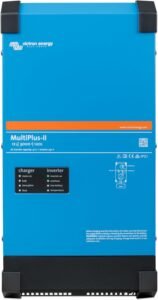
It is important that this inverter is a pure sine wave model. Coffee machines contain electronics and heating elements that are designed for clean AC power, and modified sine wave inverters often cause problems, unstable operation or even damage over time. We use a Victron MutliPlus 3000VA to power the Nespresso machine without any effort.
Need help with designing your electrical system?

If you are building an off-grid system and want to make sure all these numbers actually come together in a safe and correct way, our software can help. It lets you select your battery, inverter and appliances and automatically calculates cable sizes, fuse ratings and system compatibility, so you can see in one clear diagram how everything should be wired. It takes away a lot of guesswork and helps you avoid the kind of mistakes that only show up once things start failing in real life.

A wiring diagram of a victron multiplus build with girdless solutions software

How much current does the battery need to deliver?

This is where things get interesting, because the inverter does not magically turn 12 volt battery power into 230 volt AC without losses. A good inverter is about 90 percent efficient, which means that to deliver 1500 watts of AC power, it needs to pull more power from the battery.

Efficiency calculation
1500 W ÷ 0.9 = 1667 W from the battery

Now we translate that into battery current. On a 12 volt system, that power draw becomes:

Current calculation
1667 W ÷ 12 V = 139 A

So in practice, when your Nespresso is running through a 1500 watt inverter, your battery has to supply roughly 140 amps continuously. And that is just for the inverter. Lights, fridge, pumps and other devices will add to that. This is why, in a realistic system, you should assume that you need around 150 amps of discharge capability.

Why battery type matters

Not all batteries are created equal when it comes to delivering high currents. Traditional AGM and gel batteries should not be discharged faster than about 20 percent of their total capacity per hour. This is often referred to as the 0.2C rule. A 100 amp-hour AGM battery can therefore safely supply only about 20 amps continuously. To reach 150 amps while staying within that safe range, you would need 750 amp-hours of AGM capacity, which is extremely large, heavy and impractical for most off-grid setups.

Lithium batteries, specifically LiFePO4, behave very differently. Their discharge capability is not limited by chemistry in the same way, but by the battery management system, or BMS. A typical 100 amp-hour lithium battery can usually deliver around 100 amps, and larger batteries often have 150 or 200 amp BMS units. This means that a single properly designed lithium battery can easily supply the 150 amps needed for a coffee machine through an inverter.

Real-world battery examples

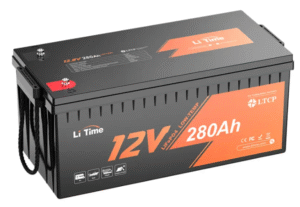
From practical testing, two batteries in this class stand out. The LiTime 280 amp-hour battery uses a 200 amp BMS, which means it can comfortably supply the 150 amp load we calculated. It is a solid battery, although the base version does not include Bluetooth monitoring. A Bluetooth version is available at a higher price.

Another strong option is the WattCycle 314 amp-hour Mini battery. It also has a 200 amp BMS but offers more capacity and built-in Bluetooth monitoring, and it is often cheaper. From an off-grid power perspective, both of these batteries are more than capable of running a 1500 watt inverter for a Nespresso machine.
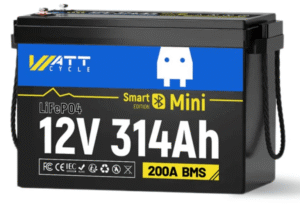
wattcycle 314ah mini battery
Get 6% discount with code: Gridless

Available at

wattcycle.com
litime 280Ah battery
Enjoy 6% discount with code: Gridless

Available at

litime.com

Final recap

If you want to make a cup of coffee with a Nespresso machine off-grid, you need to design your system around real electrical loads. A Nespresso uses about 1300 watts, which means you should choose a 1500 watt pure sine wave inverter. That inverter will draw roughly 140 to 150 amps from a 12 volt battery while brewing, so your battery must be able to handle that current. AGM and gel batteries become impractically large at that discharge rate, which is why a lithium battery with at least a 150 amp, preferably 200 amp, BMS is the realistic solution.

Leave a Comment

Your email address will not be published. Required fields are marked *

Scroll to Top