Running an airfryer off-grid sounds simple, until you actually try it and your inverter overloads, your battery voltage drops, or the battery management system shuts the whole thing down. An airfryer is a high-power appliance, and it exposes weak electrical setups immediately. In this article, we are going to look at what you actually need to run an airfryer from a battery system, using real electrical numbers instead of guesswork. We will walk through how much power an airfryer draws, how to choose the right inverter, what that load looks like on the DC side of your system, and what type of battery can realistically handle it without constant shutdowns.
The short version is this: to reliably run an airfryer off-grid, you want a pure sine wave inverter in the 1500 watt range, and a lithium battery with a BMS that can handle roughly 150 amps of continuous discharge. Below we’ll go through the full reasoning so you understand exactly why, and so you can design your camper, van, 4×4 or boat electrical system the right way.
Table of Contents
How much power an airfryer really uses
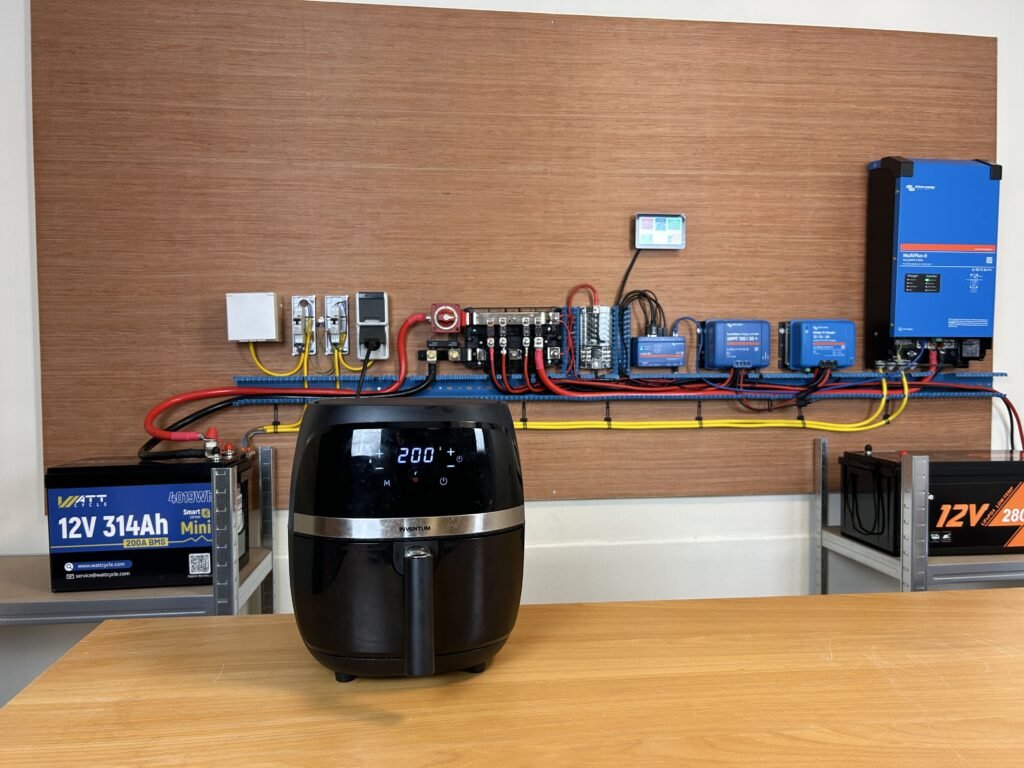
Every airfryer has a power rating printed on the label or in the manual. In our case, the unit we tested is rated at 1300 watts. That number refers to how much AC power the airfryer draws while it is actively heating. When you are connected to shore power at home, that electricity comes straight from the power outlet. When you are off-grid, that same power has to come from your battery, through your inverter.
This is where many people underestimate what is really happening. A 1300-watt airfryer does not mean the battery only sees 1300 watts. The inverter that converts DC battery power into AC household power is not perfectly efficient. Most high-quality inverters are around 90 percent efficient, which means your battery actually has to deliver more power than the appliance uses. The difference is lost as heat inside the inverter.
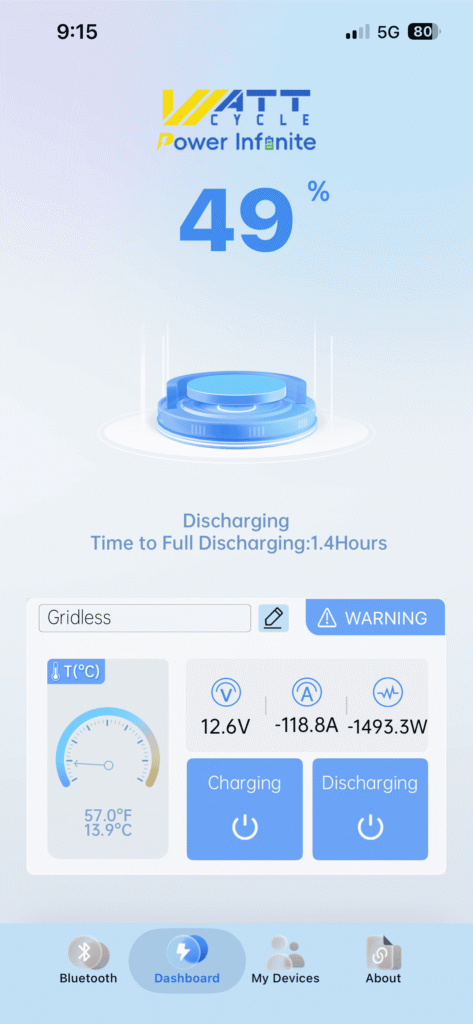
Here you see a screenshot from our WattCycle battery monitor (Bluetooth app). When we run our 1300 W airfryer through the inverter (Victron MultiPlus), the battery has to deliver about 1493 W, which equals roughly 118 A on a 12 V system. This already shows how quickly currents rise when you use high-power 230 V appliances off-grid.
From these numbers we can also calculate the inverter efficiency. The airfryer uses 1300 W on the AC side, while the battery supplies 1493 W on the DC side. The efficiency is therefore:
1300 W ÷ 1493 W × 100% = 87.1%
This means the inverter is about 87% efficient in this situation. The remaining 193 W, or roughly 12.9%, is lost as heat and internal losses inside the inverter. This is completely normal for high loads and clearly illustrates why powerful AC appliances place such a heavy demand on the battery in a camper system.
Choosing the right inverter for an airfryer
An inverter is the heart of any off-grid AC system. It takes low-voltage DC power from your battery and turns it into the 120-volt or 230-volt AC power that appliances like an airfryer need. If your airfryer uses 1300 watts, your inverter must be able to supply at least that amount of power continuously, not just for a short surge.
In real life, however, you are almost never running only one device. You might be charging a phone, using a laptop, running a fridge compressor, or turning on lights while the airfryer is heating. That means the inverter must be sized not just for the airfryer, but for the combined load of everything that could be running at the same time. In practice, that pushes you toward an inverter in the 1500-watt range or higher for a typical off-grid cooking setup.
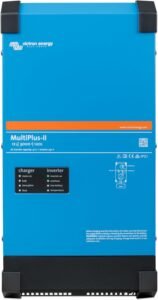
There is also one technical detail that matters a lot with appliances that use heating elements and electronics: you always want a pure sine wave inverter. Modified sine wave inverters are cheaper, but they produce a distorted waveform that can cause airfryers, coffee machines, and other appliances to run hotter, less efficiently, or even fail prematurely. A pure sine wave inverter delivers clean, grid-like power and keeps your equipment safe. We’d advise to use a Victron MultiPlus.
Available at
Need help with designing your electrical system?
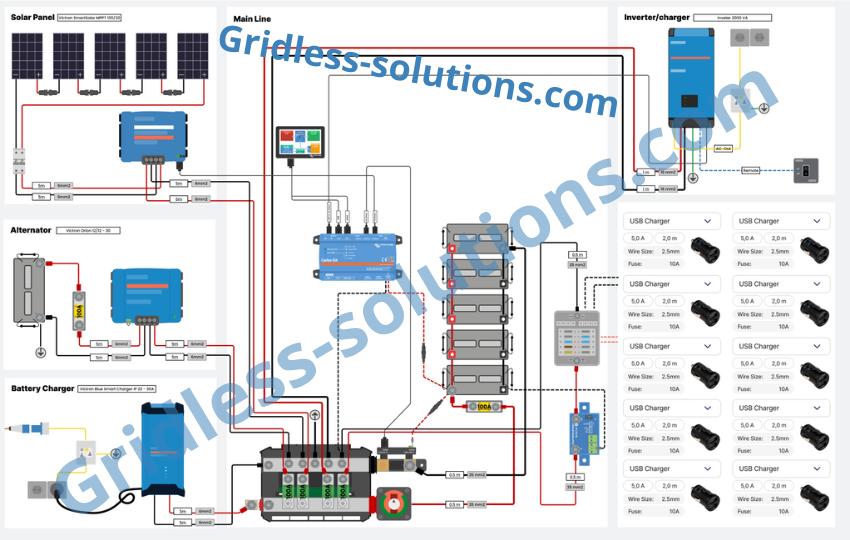
If you are building an off-grid system and want to make sure all these numbers actually come together in a safe and correct way, our software can help. It lets you select your battery, inverter and appliances and automatically calculates cable sizes, fuse ratings and system compatibility, so you can see in one clear diagram how everything should be wired. It takes away a lot of guesswork and helps you avoid the kind of mistakes that only show up once things start failing in real life.
Why battery choice matters more than most people think
Once the inverter is chosen, many people assume they can simply connect it to any battery and everything will work. This is where most off-grid airfryer setups go wrong. Batteries are not only defined by how much energy they store, but also by how fast they can deliver that energy. This is known as the discharge rate.
Traditional lead-acid batteries such as AGM or gel types are limited in how much current they can safely provide. A common rule of thumb is that they should not be discharged continuously at more than about 20 percent of their rated capacity. A 100 amp-hour AGM battery, for example, can safely provide only about 20 amps continuously. That is nowhere near enough for a large inverter.
Lithium batteries behave very differently. A 100 amp-hour lithium battery can often deliver 100 amps or more, depending on the battery management system inside it. This is why lithium is essentially required when you want to run high-power appliances like an airfryer off-grid.
Converting airfryer watts into battery amps
To understand what your battery really has to deliver, we need to convert the airfryer’s AC power into DC battery current. For design purposes, we round the airfryer up to 1500 watts to include other small loads and some margin. Because the inverter is about 90 percent efficient, the battery has to provide about 1667 watts.
In a 12-volt system, power is converted into current by dividing watts by volts. That means 1667 watts divided by 12 volts equals roughly 139 amps. This is the continuous current your battery must supply just to run the airfryer. When you include other loads such as a fridge or lights, it is realistic to design for around 150 amps of continuous discharge.
This single number already tells you why most AGM systems fail with an airfryer. To safely deliver 150 amps at a 20 percent discharge rate, you would need a battery bank of roughly 750 amp-hours. That is heavy, expensive, and impractical in a campervan or overland vehicle.
How much battery capacity an airfryer really consumes
Power is only half the story. The other half is energy over time. How much battery capacity you need depends entirely on how long you run the airfryer. Heating a slice of bread might take ten minutes, but cooking a full meal can easily take thirty minutes or more.
At roughly 139 amps of draw, running the airfryer for one hour would consume 139 amp-hours from the battery. Running it for thirty minutes uses about half of that, around 69 amp-hours, which is about 828 watt-hours of energy. That energy has to come out of your battery before anything else, including your fridge, lights, or water pump. This is why a battery monitor becomes extremely important when using high-power appliances off-grid.
Choosing a lithium battery that can actually handle an airfryer
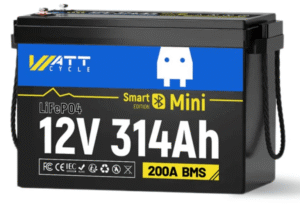
Once you know that your system must handle around 150 amps of continuous discharge, the battery choice becomes much easier. You need a lithium battery with a battery management system rated at least at that current. In practice, a 200-amp BMS gives you a safe margin and avoids shutdowns when loads spike.
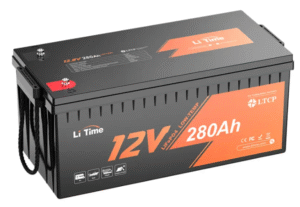
High-capacity lithium batteries in the 280 to 314 amp-hour range are ideal for this kind of use. They give you enough energy to run the airfryer for realistic cooking times while still leaving reserve capacity for the rest of your off-grid system. More importantly, their internal BMS is designed to safely deliver the current that a 1500-watt inverter demands.
Available at
Available at
Putting it all together
To run an airfryer off-grid in a camper, van, or boat, you need three things to work in harmony. You need a pure sine wave inverter rated around 1500 watts, a lithium battery with a BMS capable of at least 150 amps of continuous discharge, and a system designed with the correct cables and fuses so that this power can flow safely.
This is exactly what our design software does for you. Instead of guessing, it calculates every part of the system, from inverter load to battery current to cable size, so that appliances like an airfryer can be used with confidence.
When off-grid power is designed properly, cooking with an airfryer becomes just another normal part of van life. When it is not, it becomes one of the fastest ways to expose weak points in the system. Designing for it upfront is what makes the difference between frustration and freedom.